[caption id="attachment_3818" align="alignnone" width="433"]

A narrow section of the riverside path close to the hermit cave at Anchor Church.[/caption]
The East Cheshire Ramblers recently ventured to a new area for the group on a recent walk from Repton near Derby. The walk had a historical theme and started out with a visit to the historic St Wystan’s Church. The church has a fine Saxon Crypt which was built in the 8th century as a mausoleum for the Mercian royal family and the burial place of three Mercian kings. Repton is well known for its private school which dominates the village.
Heading east the village we set out by taking a good field path over Askew Hill and later along another path to Anchor Church which is the name given to a series of caves in a Keuper Sandstone outcrop. The caves were once home to an Anchorite hermit St Hardulph who lived here in the 6th or 7th century.
[caption id="attachment_3819" align="alignnone" width="433"]

Graham tests the water supply at one of the unique 'Ticknall Taps'.[/caption]
Continuing via Ingleby we next headed towards Ticknall on field paths. En route we paused briefly at Knowle Hill, site of a former Italian landscape garden, developed in the early seventeen hundreds which later became a pleasure garden in the 19th century before it was semi abandoned.
At Ticknall we came across the first of several ‘Ticknall Taps’ which are identical cast iron water pumps installed around 1914 by Sir Harper Crewe to, what was then, the estate village to nearby Calke Abbey which provided fresh water.
In the grounds of the village hall we stopped for lunch by which time the sun was breaking through. We explored the village afterwards including stopping at the old lock up and visiting Sheffield House, an imposing three-storey house with the top floor being false. It was built in the 1840s by George Sheffield, who was a doctor, and William Sheffield, who was a veterinary surgeon. They emphasized the size and independent status of their property by adding a false third storey that carries the name ‘Sheffield’ prominently on its parapet.
[caption id="attachment_3820" align="alignnone" width="1363"]

A clever disguise. Sheffield House in the village of Ticknall has a false third floor.[/caption]
Finally it was a visit to the churchyard to view the parish church and the remains of the medieval church. When the new church was built by the Victorians, they opted to blow up the old church leaving just the few ruins we see today. The return to Repton was initially along part of the National Forest Way and crossed numerous fields. The day was rounded off with a visit to Mrs Bee’s Tearooms in the nearby village of Findern.
[caption id="attachment_3821" align="alignnone" width="1363"]

The parish church at Ticknall. So what do you do when the medieval church becomes redundant. In this case, the Victorian's simply blew it up leaving these remains in the churchyard.[/caption]




 A narrow section of the riverside path close to the hermit cave at Anchor Church.[/caption]
The East Cheshire Ramblers recently ventured to a new area for the group on a recent walk from Repton near Derby. The walk had a historical theme and started out with a visit to the historic St Wystan’s Church. The church has a fine Saxon Crypt which was built in the 8th century as a mausoleum for the Mercian royal family and the burial place of three Mercian kings. Repton is well known for its private school which dominates the village.
Heading east the village we set out by taking a good field path over Askew Hill and later along another path to Anchor Church which is the name given to a series of caves in a Keuper Sandstone outcrop. The caves were once home to an Anchorite hermit St Hardulph who lived here in the 6th or 7th century.
[caption id="attachment_3819" align="alignnone" width="433"]
A narrow section of the riverside path close to the hermit cave at Anchor Church.[/caption]
The East Cheshire Ramblers recently ventured to a new area for the group on a recent walk from Repton near Derby. The walk had a historical theme and started out with a visit to the historic St Wystan’s Church. The church has a fine Saxon Crypt which was built in the 8th century as a mausoleum for the Mercian royal family and the burial place of three Mercian kings. Repton is well known for its private school which dominates the village.
Heading east the village we set out by taking a good field path over Askew Hill and later along another path to Anchor Church which is the name given to a series of caves in a Keuper Sandstone outcrop. The caves were once home to an Anchorite hermit St Hardulph who lived here in the 6th or 7th century.
[caption id="attachment_3819" align="alignnone" width="433"] Graham tests the water supply at one of the unique 'Ticknall Taps'.[/caption]
Continuing via Ingleby we next headed towards Ticknall on field paths. En route we paused briefly at Knowle Hill, site of a former Italian landscape garden, developed in the early seventeen hundreds which later became a pleasure garden in the 19th century before it was semi abandoned.
At Ticknall we came across the first of several ‘Ticknall Taps’ which are identical cast iron water pumps installed around 1914 by Sir Harper Crewe to, what was then, the estate village to nearby Calke Abbey which provided fresh water.
In the grounds of the village hall we stopped for lunch by which time the sun was breaking through. We explored the village afterwards including stopping at the old lock up and visiting Sheffield House, an imposing three-storey house with the top floor being false. It was built in the 1840s by George Sheffield, who was a doctor, and William Sheffield, who was a veterinary surgeon. They emphasized the size and independent status of their property by adding a false third storey that carries the name ‘Sheffield’ prominently on its parapet.
[caption id="attachment_3820" align="alignnone" width="1363"]
Graham tests the water supply at one of the unique 'Ticknall Taps'.[/caption]
Continuing via Ingleby we next headed towards Ticknall on field paths. En route we paused briefly at Knowle Hill, site of a former Italian landscape garden, developed in the early seventeen hundreds which later became a pleasure garden in the 19th century before it was semi abandoned.
At Ticknall we came across the first of several ‘Ticknall Taps’ which are identical cast iron water pumps installed around 1914 by Sir Harper Crewe to, what was then, the estate village to nearby Calke Abbey which provided fresh water.
In the grounds of the village hall we stopped for lunch by which time the sun was breaking through. We explored the village afterwards including stopping at the old lock up and visiting Sheffield House, an imposing three-storey house with the top floor being false. It was built in the 1840s by George Sheffield, who was a doctor, and William Sheffield, who was a veterinary surgeon. They emphasized the size and independent status of their property by adding a false third storey that carries the name ‘Sheffield’ prominently on its parapet.
[caption id="attachment_3820" align="alignnone" width="1363"]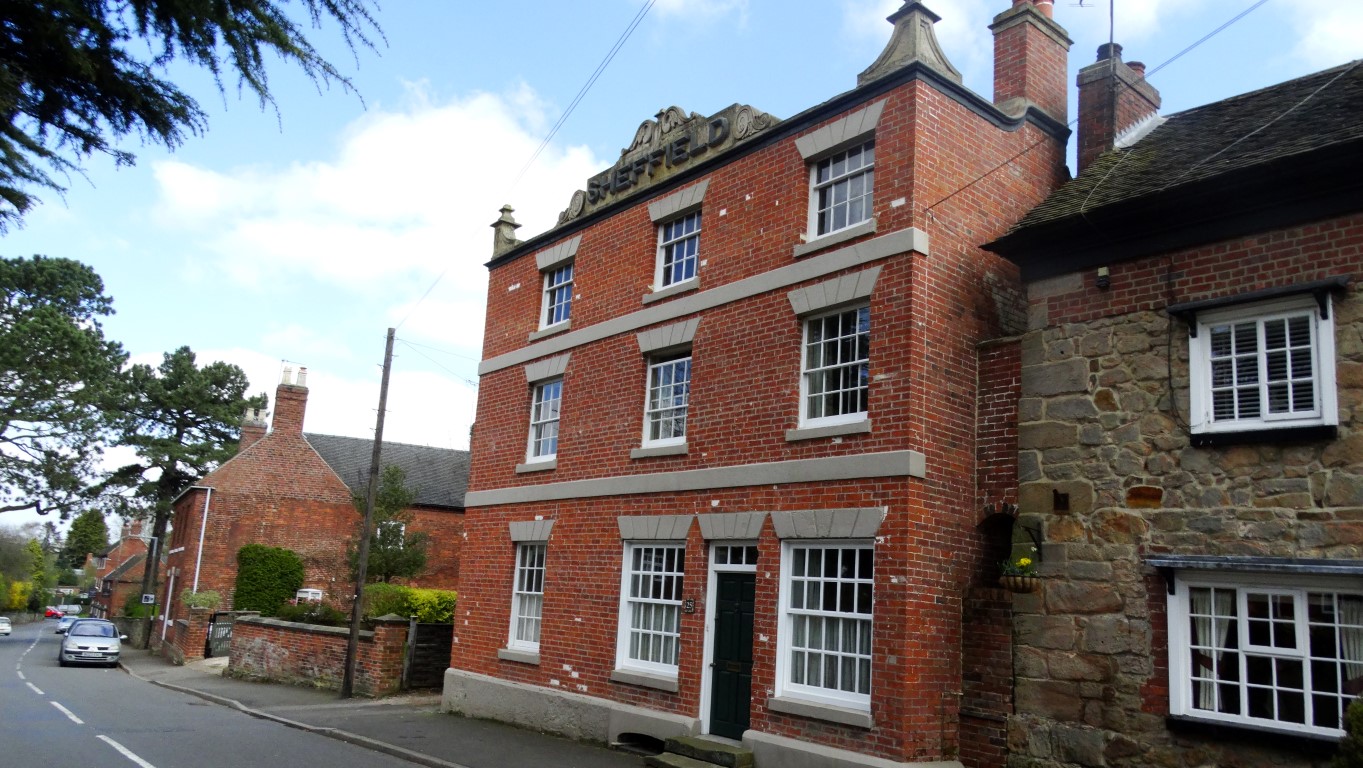 A clever disguise. Sheffield House in the village of Ticknall has a false third floor.[/caption]
Finally it was a visit to the churchyard to view the parish church and the remains of the medieval church. When the new church was built by the Victorians, they opted to blow up the old church leaving just the few ruins we see today. The return to Repton was initially along part of the National Forest Way and crossed numerous fields. The day was rounded off with a visit to Mrs Bee’s Tearooms in the nearby village of Findern.
[caption id="attachment_3821" align="alignnone" width="1363"]
A clever disguise. Sheffield House in the village of Ticknall has a false third floor.[/caption]
Finally it was a visit to the churchyard to view the parish church and the remains of the medieval church. When the new church was built by the Victorians, they opted to blow up the old church leaving just the few ruins we see today. The return to Repton was initially along part of the National Forest Way and crossed numerous fields. The day was rounded off with a visit to Mrs Bee’s Tearooms in the nearby village of Findern.
[caption id="attachment_3821" align="alignnone" width="1363"]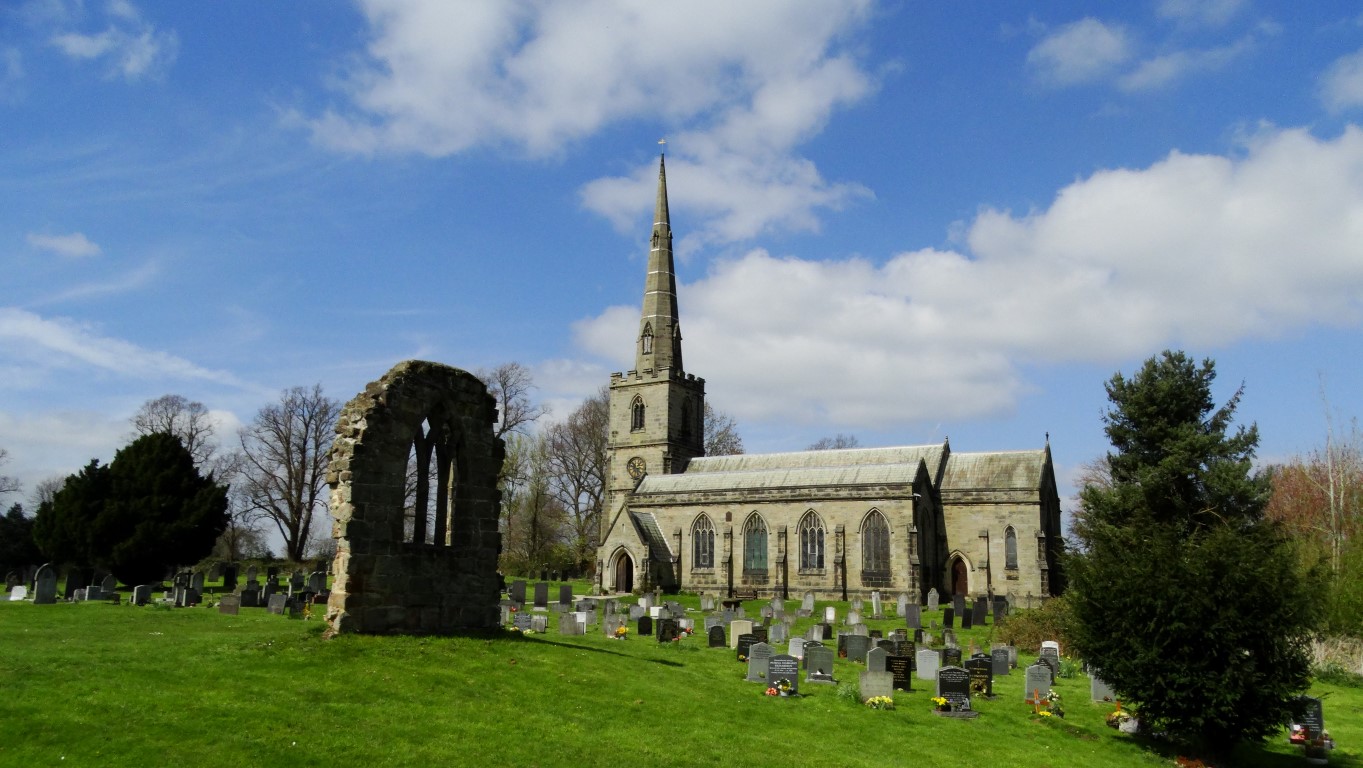 The parish church at Ticknall. So what do you do when the medieval church becomes redundant. In this case, the Victorian's simply blew it up leaving these remains in the churchyard.[/caption]

