



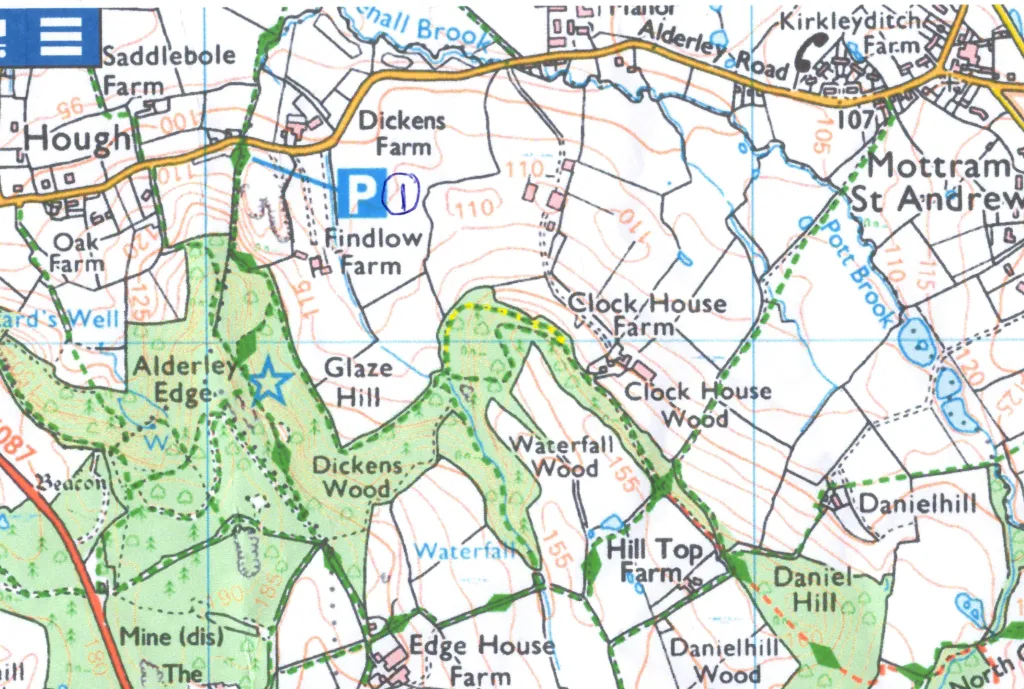
Clock House Wood, inhabits National Trust land just northeast of, and below, Alderley Edge. Within it, a public footpath (Over Alderley FP 2) follows the wood's north perimeter. ECR Footpath Inspectors since 2010, have been reporting its condition on ECR's footpath database as comprehensively lost and unwalkable and giving it ECR's worst rating as Category D 'Obstructed'. This summer, ECR Footpaths Committee asked me if our Footpaths Project Team would prioritise restoring the path to a faultless Category 'A'. I confirmed the route with GPS and walking it with FP committee member, Nick Brearley. Nick had liaised with Tim, an NT Ranger at Alderley Edge, to enable our project.
Ten of the Project Team volunteered over three Fridays during June and July for this work. Our initial task was clearance of dead trees and branches lying on and over the path, clearing excessively low and overhanging trunks and branches, and especially cutting back or removing intrusive holly trees and bushes. And, taking down dead trees and branches propped up by live tree branches!
Completion of that work cleared the sightlines along the path. Negligable footfall of casual walkers was evident to indicate the path's line, thus six new waymarker posts were placed in optimal positions along the path line to restore visual evidence of the route. Their tops were painted yellow for visibility. Way-marking disks were fixed to the posts, and a blue 7.5cm square plaque added to the posts near each end of the path. The latter acknowledge ECR volunteers' improvements and invite readers to be members.
Near the southwest end of the path, rounded and worn gritstone, with a crossfall and covered in vegetation, presents a difficult passage with risk of falls and injuries. The initial intention was to chip away the rock to form steps and flats. This proved difficult and team members chose to recover and transport suitable cut branches to the section and placed them to support footfalls along the lower side of the path. Subsequently, pegs were driven to support the timbers.
Ten team members assisted, on one or more of the three days, and made, in all, 20 attendances, during which 70.5 man-hours work (excluding breaks) was carried out. This included working in very heavy rainfall on Friday 19th July! I'd like to thank Janet Allan, Adrian Flinn, Ken Hobbs, Roger Jubb, Chris Munslow, Frances Moore, Steve Osborne, Nick Wild, and Alan Wilson for their very successful work.


